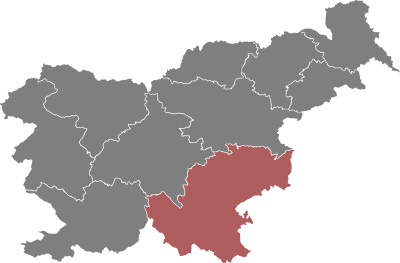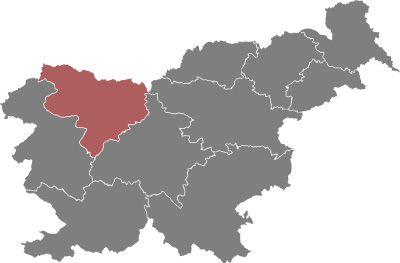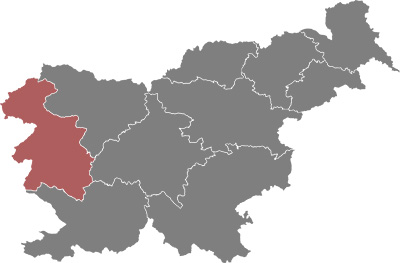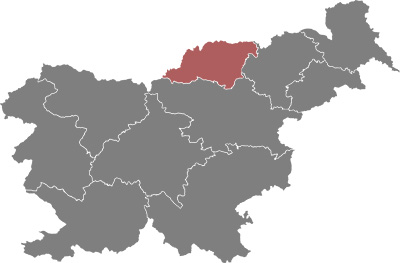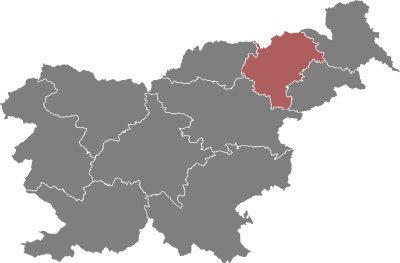

The history of the Slovenian people during the Second World War is woven from thousands of tragic fates, but few stories tell of a single household subjected to such complete, merciless destruction and, at the same time, such boundless courage as that of the Mlinar family (known locally as the Soldat family) from Šentjanž in the Upper Savinja Valley. This is a chronological account of the family and of the invisible bond of blood that endured through generations, so that their names might be rescued from oblivion.
The family’s roots: Two sisters and one home
The foundations of this family were laid by love and familial devotion, values deeply respected in the Slovenian countryside at the time. Their father, Franc Mlinar Sr., first married Marija Vertot, who bore him children, including a daughter, Ana “Ančka” Mlinar (born 13 April 1918), Slavko (born 7 May 1920), and Franc Jr. (born 31 December 1912). When Marija died young, her own sister, Apolonija Vertot (born 28 January 1890), took on the care of the orphaned children and the household. Apolonija married the widower Franc and gave birth to two more children: a daughter, Jožefa “Pepca” Mlinar (born 15 August 1924), and the youngest son, Karel (Karli) Mlinar (born 26 October 1925). Ana and Pepca were therefore half-sisters, while their mothers were biological sisters—a bond that wove the family into an inseparable whole.
The fateful summer of 1942: Going underground and the Gestapo’s revenge
When German occupying forces took control of the Savinja Valley in 1941, the two older sons, Franc Mlinar Jr. and Slavko Mlinar, resolutely committed themselves to the resistance. On 17 June 1942, they left their family home and joined the Partisans. In response, the Nazi authorities launched a devastating measure of collective punishment against families (Sippenhaft).
In July 1942, the Gestapo surrounded the Mlinar home. They arrested everyone who was at home at the time—mother Apolonija (52), Pepca, barely 17, and the youngest, Karel. On the same day, at the Možic farmstead in Zgornje Pobrežje, they arrested Ana (Soldatova Ančka), the sister, and her aunt Ana Mlinar (Možicova Ana, her father’s sister), the farm’s owner, who had run it together with her niece after she was left alone there. They were taken to the notorious Gestapo prison, Stari pisker, in Celje.
On the day his wife and two children were arrested, father Franc Sr. returned home in the evening to find the house empty. To save his life, he first hid in the church bell tower in Šentjanž, where he watched for German patrols, and then went completely underground and joined the National Liberation Struggle (NOB) directly.
Transport to hell: The line at Auschwitz (July 1942)
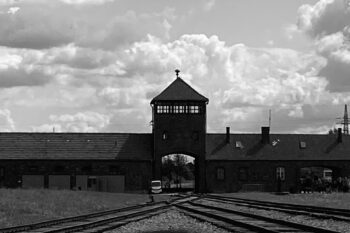
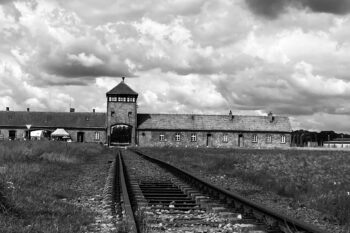
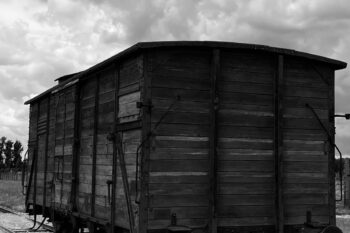
A few days later, the German authorities loaded the captured women from Celje into sealed, overcrowded cattle wagons. Karel, then only sixteen, had already been separated from the women that morning and sent elsewhere; I write more about this at the end. After several days of agonising travel without water or toilets through Austria and Czechoslovakia, the train carrying the women arrived at the camp ramp at Auschwitz. As political prisoners from Slovenia (designation Pol:S), they were not sent straight to the gas chambers, but to the camp’s identification office (Erkennungsdienst).
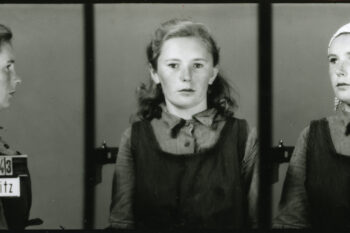
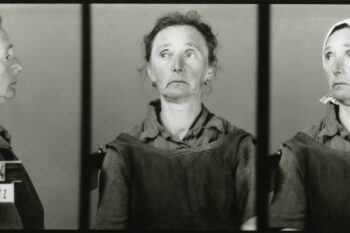
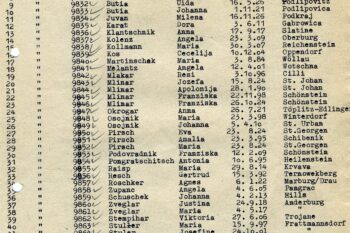
Jožefa (Pepca) Mlinar, then still 17, was assigned camp number 9843. Her haunting registration portrait was taken there: she still had long, wavy hair and wore a camp work uniform and a checked headscarf, which was required by the photography protocol.
Her mother, Apolonija Mlinar, stepped forward immediately after her and was assigned the next number, 9844.
The older daughter, twenty-four-year-old Ana (Ančka), and their aunt Ana (47) were also registered in the same series of numbers.
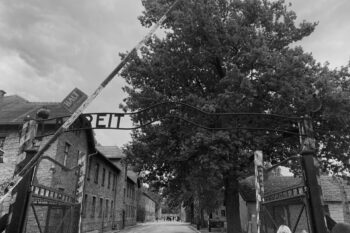
At first they were imprisoned in the brick blocks of Auschwitz I; in mid-August 1942, as part of a mass transfer, they had to walk to the muddy, unfinished hell of the wooden barracks at Auschwitz II–Birkenau (Sector B).
Five months of terror: A chronicle of dying (September 1942 – January 1943)
In barely five months, the machinery of occupation destroyed almost the entire family. Family members died one after another in different parts of Europe, unaware of one another’s fate:
September 1942 (Auschwitz-Birkenau): The first to succumb was mother Apolonija Mlinar (52). Her body most likely could not withstand the brutal first wave of the typhus epidemic that ravaged Birkenau that autumn. Her body was cremated, and her ashes scattered in nearby rivers or marshes.
2 October 1942 (Maribor): While her daughters suffered in Poland, the Nazis tortured the older son, Franc Mlinar Jr., in Maribor and shot him as a hostage that same day, along with other patriots. He was 29.
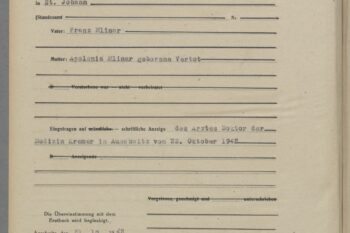
23 October 1942 (Auschwitz-Birkenau): Just one month after her mother, the life of 18-year-old Pepca Mlinar came to an end at 14:20 (the official time of death recorded on her death certificate). She had turned 18 in the camp in August. The SS doctor Dr Johann Paul Kremer entered the likely false diagnosis “angina with physical debility” on her death certificate, as was common practice at the time. In reality, the young woman most likely succumbed to the inhuman conditions, starvation, and immense emotional distress following her mother’s death.
24 December 1942: Pepca’s aunt, Ana Mlinar (Možicova) (47), died at Auschwitz.
8 January 1943 (Osankarica, Pohorje): The second son, Slavko Mlinar, who fought as a Partisan under the nom de guerre Trdi (Trdina), met his end as a fighter in the famed Pohorje Battalion. In a brutal, unequal battle, when 2,000 German soldiers surrounded the camp at Trije žeblji on Osankarica, he fell with all his fellow fighters amid the snow of the Pohorje. He was 22.
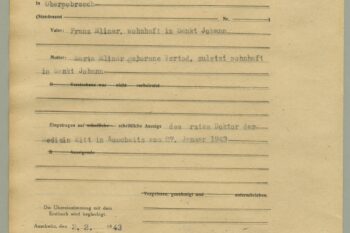
27 January 1943 (Auschwitz-Birkenau): The last of the women in the camp to die was the older sister, Ana Mlinar (24), after a long, heroic struggle against the icy winter and hunger. She died at 9:40. The SS doctor Dr Bruno Kitt bureaucratically recorded her cause of death as “acute catarrh of the gastrointestinal tract.” Ana died exactly two years before the official liberation of Auschwitz, on a day we now know as International Holocaust Remembrance Day.
Father Franc Mlinar Sr. endured the entire arduous Partisan struggle, fought throughout the war, and fell as the last surviving fighter in the immediate family, just before the threshold of freedom, in 1945, during a fierce battle in the hamlet of Štance Laze in Moravče.
The only survivor: The weight of Grandpa Karel’s silence
The only person from this household to survive this apocalypse was the youngest son, Karel (Karli) Mlinar. In Celje, the Germans separated him from the women and deported him, a sixteen-year-old boy, to a youth camp in Austria, which physically saved his life.
When, after the war in 1945, he returned to his native Šentjanž, completely alone and exhausted, a twenty-year-old after three years in the camp, he was stopped outside a local inn on his way home. There, the locals told him the devastating truth: Everyone in your family is dead. There is no one left. He later described the kilometre-long walk from the inn to the empty home to his son—my father—with words that cut to the heart: “I walked as if I were wading through water up to my waist.” This unbearable weight of grief, survivor’s guilt, and utter loneliness proved fatal for a twenty-year-old. The war killed him belatedly—through the breaking of his soul. In May 1967, aged just 41 (ten years before I was born), he took his own life. He never spoke about the events, apart from that walk home. My father was 13 when his father died.
Closing the circle: A light that overcame oblivion
The Nazi system wanted to erase the Soldat family of Šentjanž completely, to turn them into ashes and mere numbers, but its intention did not prevail. A new generation was born through Grandpa Karel, and through that generation, I was born.
Although I never knew my ancestors personally, even as a teenager I felt the quiet call of Pepca’s name. That call drove me to search the internet curiously at least once a year, hoping to find a picture or some information about my Pepca. And fate—or God’s plan—led me precisely to my goal.
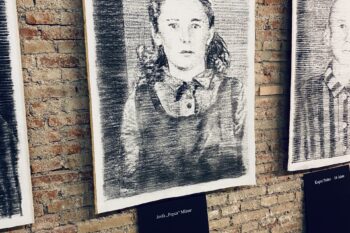
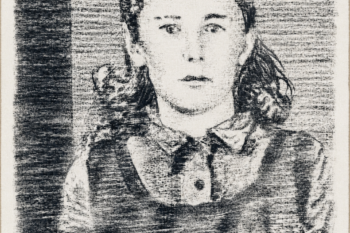
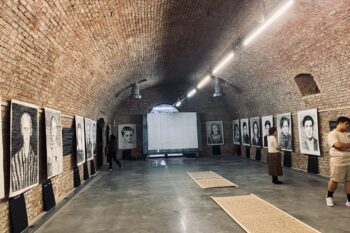
Three years ago, online, I recognised features resembling my own in a haunting charcoal portrait. The caption beneath the picture read, “Josefa ‘Pepca’ Mlinar, killed in Auschwitz age 18.” The portrait was created as part of the project “Drawing against oblivion/Risano proti pozabi” by German-Austrian artist Manfred Bockelmann, who uses the Auschwitz picture archive as a basis for drawing murdered children in charcoal on large canvases. He has been doing this for years; it is his life’s work. This artwork and my contact with the person who manages the website that published it were enough for me, soon afterwards, with the help of staff at the Auschwitz museum, to find and obtain documentation about my female relatives: prisoner photographs, death certificates, all the papers of theirs that survived the deliberate destruction shortly before the German capitulation.
At the invitation of David Kunač, a German director of Slovenian descent who captured the artist’s work in the documentary film of the same name, “Drawing against oblivion,” I went to Mr Bockelmann’s exhibition in Munich on 19 May 2023. When I entered the large room filled with portraits of murdered children, I felt as if I had come to a sacred place or a funeral. Everything was quiet and heavy. The silence itself seemed to overwhelm my body. Then I saw her. It struck me in the soul! Before me stood a portrait of Pepca, more than a metre tall. It seemed as though she were alive. As if she were about to smile at me. I stood before her and felt her words in my soul: “Well, you’ve found me at last.” The experience was extraordinarily emotional for me.
The artist, a family friend of the director, gave me Pepca’s portrait at his home in Klagenfurt just under three months later. For two years, Pepca stayed safely by my side—finally symbolically returned home, to her own people. I kept her with me to protect her from the world. After two years, I felt that she should no longer be hidden within four walls, but should be brought among people. I donated her portrait to the Museum of National Liberation in Maribor, which is also connected to her brother Slavko through the fall of the Pohorje Battalion. I wanted to show her face to the world, and with it her sad story, a story from Slovenia’s dark history.
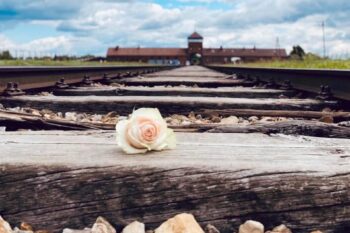
In August 2023, I travelled to Auschwitz-Birkenau. I laid a white rose on the wooden railway tracks that had carried my mother’s family—Apolonija, Pepca, and both Anas—to their deaths. At that moment, they were no longer alone or forgotten.
In the middle of winter that same year, I made my way in the silence of the snow to Osankarica, where Slavko died. There, too, it was peaceful and moving.
Love is the force that broke through more than eight decades of silence, the mud of Auschwitz, and the darkness. For a long time, I wondered why the name Pepca had haunted me so powerfully since my youth, and why this girl, whom I had never known, had lived deep inside me all these years. Today I know it was no coincidence. I understand that every step I took—every one of those online searches as I stared into empty fields—was part of a higher plan. My blood and soul recognised the call of those ancestors who had waited too long in the darkness and cold of Auschwitz.
When I saw Pepca’s portrait in the middle of Munich and recognised my own facial features in her eyes, that thought—“Well, you’ve found me at last”—cut deeply into my soul. I did not weep only with sorrow at her fate; I was moved that my modest wish had finally broken through the silence of the camp and transcended death. Through the artist Manfred and the director David, fate led me precisely to the moment when I could look into her eyes, even if only in a picture, and embrace her in my thoughts. I know that finding her and bringing her home was my mission. I stepped into that deep, leaden water in which Grandpa Karel had to wade, completely alone and heartbroken, in 1945. Back then, he did not have the strength to try to understand what cannot be understood; fate had laid the heavy burden of silence upon him, and I symbolically walked the final part of the way with him, years later. I drew all their memories out of that water and brought them into the light.
With the white rose I laid on the railway tracks at Birkenau and my solitary winter visit to Slavko at Osankarica, I brought their fates together. My great-grandmother Apolonija, my Pepca, both Anas, both Francs, and Slavko are not merely dry German statistics. By donating the portrait to the museum, I gave Pepca eternity and protected her from time—I sent her out into the world as a victor over hatred.
Love heals all family wounds. Now that I have come to know the Soldat family better, I know more clearly who I am, whose blood I carry, and why I have such a distinct character. The heroic family of my ancestors has found its peace, and I have found mine—in the knowledge that they will live on through my memories and testimony.