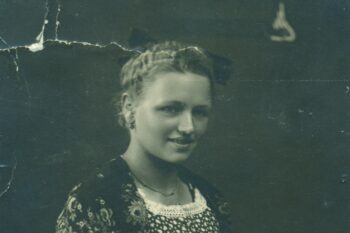
One hundred and twenty‑five years ago, Leopoldine Köberl was born in Maribor. In 1993 she was declared dead under the name Leopoldina Pečar. As her grandchildren, we knew little about her life; regarding her death, only that she had been arrested in May 1945 and never returned home. She was never officially declared missing, and occasional inquiries brought no results. In the past two years, however, we have uncovered enough traces of our grandmother Leopoldina’s fate to finally place her within both our family history and the history of Styria.
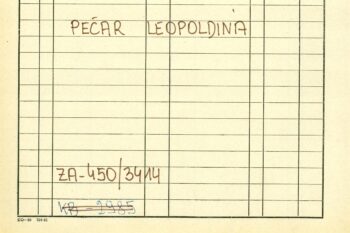
The first attempts to find answers to the naïve question Why would anyone, after the liberation, take an ordinary housewife away into the unknown? date back to the early 1970s. Leopoldina’s grandson Darko, then an enthusiastic student, gathered his courage and went—already in socialist Yugoslavia—to the Maribor municipal office to ask about his grandmother. After checking the records, the clerk simply told him that he should leave immediately, for his own good. Twenty years later, officials at the Ministry of the Interior of the Republic of Slovenia were also terse. At the request of the grandson, they sent Leopoldina’s daughter the contents of the file of Leopoldina Pečar, which included a statement, an interrogation, an indictment, and a short note ending with the sentence: “We do not keep any other information about her fate in our Archive.”
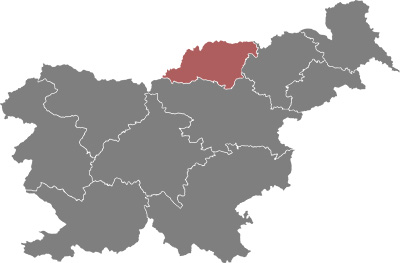
In 2009, Leopoldina Pečar was entered into the register of victims of the Second World War, which contains more than one hundred thousand names of people who, during the war and immediately after it (May 1940–January 1946), had residency rights in the territory of present‑day Slovenia and lost their lives due to wartime and post‑war (revolutionary) violence or the consequences of war. The record showed that during the war Leopoldina lived in Kamnica, in the region of Lower Styria, that she was married and a housewife by occupation. Under nationality, a question mark was entered; under wartime status, “civilian.” Her date of death was listed as 31 May 1945, place of death Maribor, cause of death “missing,” and under perpetrator, again a question mark. Our family learned of this entry in 2010, but despite the new questions it raised, further inquiry still seemed impossible.
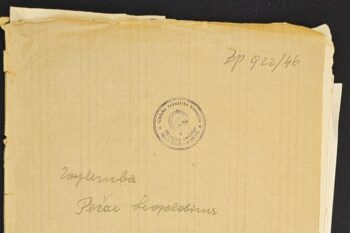
In 2024, however, with the help of researchers from the Institute of Contemporary History, court file 722/46 was discovered in the Regional Archives of Maribor. It shows that in 1950 Leopoldina’s daughter Poldika submitted a request to the Maribor District Court to reopen the confiscation proceedings by which all of Leopoldina Pečar’s property had been seized in August 1945. The final document in the file is a ruling of the Maribor Regional Court, which, at the second instance, decided not to grant the appeal due to “the established fact that the liable party collaborated with the occupier’s commission for the expulsion of Slovenes.” The ruling ends with the sentence: “The appeal must therefore be denied any success.”
Yet the new research proved successful and finally provided solid answers to the persistent questions about our Styrian grandmother: Who was Leopoldina? Did she truly do anything “to the detriment of our people”? How did her life end?
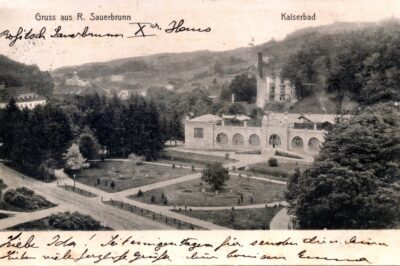
The life story of Leopoldina Pečar is presented within the context of the time and place of the first half of the 20th century in Lower Styria—a region that has only recently begun to receive proper historical attention. This attention and fair treatment are deserved not only by Leopoldina, but by hundreds of Styrian grandmothers. In the register of victims of the Second World War, there are 631 names of women from Styria who, after the war, became victims of post‑war killings or disappeared. Some were very young; most had children and later grandchildren who, to varying degrees, carried the burden of an unknown guilt and a strange silence.