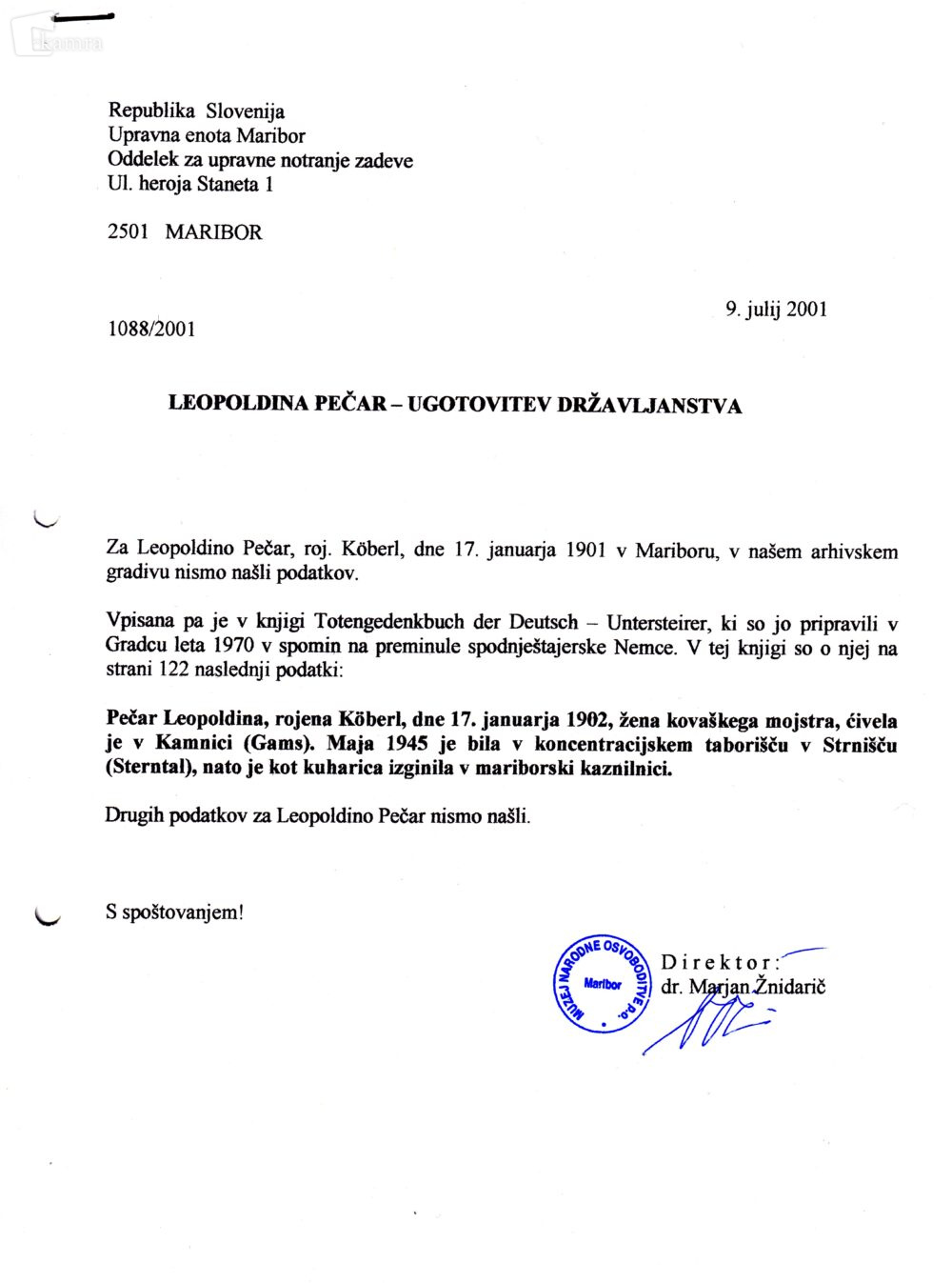

During the research into Leopoldina’s life, we received a letter from the Museum of National Liberation Maribor informing us for the first time about the book Totengedenkbuch der Deutsch‑Untersteirer, published in Graz in 1970 by the association Die Landmannschaft der Deutsch‑Untersteirer in Österreich. On page 122 it states: “Pečar Leopoldina /…/ In May 1945 she was in the concentration camp in Strnišče (Sterntal), then she disappeared as a cook in the Maribor prison.” The source of this information—which does not fully align with archival and oral accounts of Leopoldina’s fate—is unknown. Nor is it clear why the Maribor Administrative Unit consulted the Museum of National Liberation in 2001 while determining her citizenship.
What is certain is that a copy of the book reached the Institute for the History of the Workers’ Movement in Ljubljana immediately after publication, where the historian Tone Ferenc was then director. Only a few years earlier, he had completed his doctorate on Nazi denationalization policy in Slovenia (1941–1945) and was therefore an expert on wartime and post‑war events in Styria.
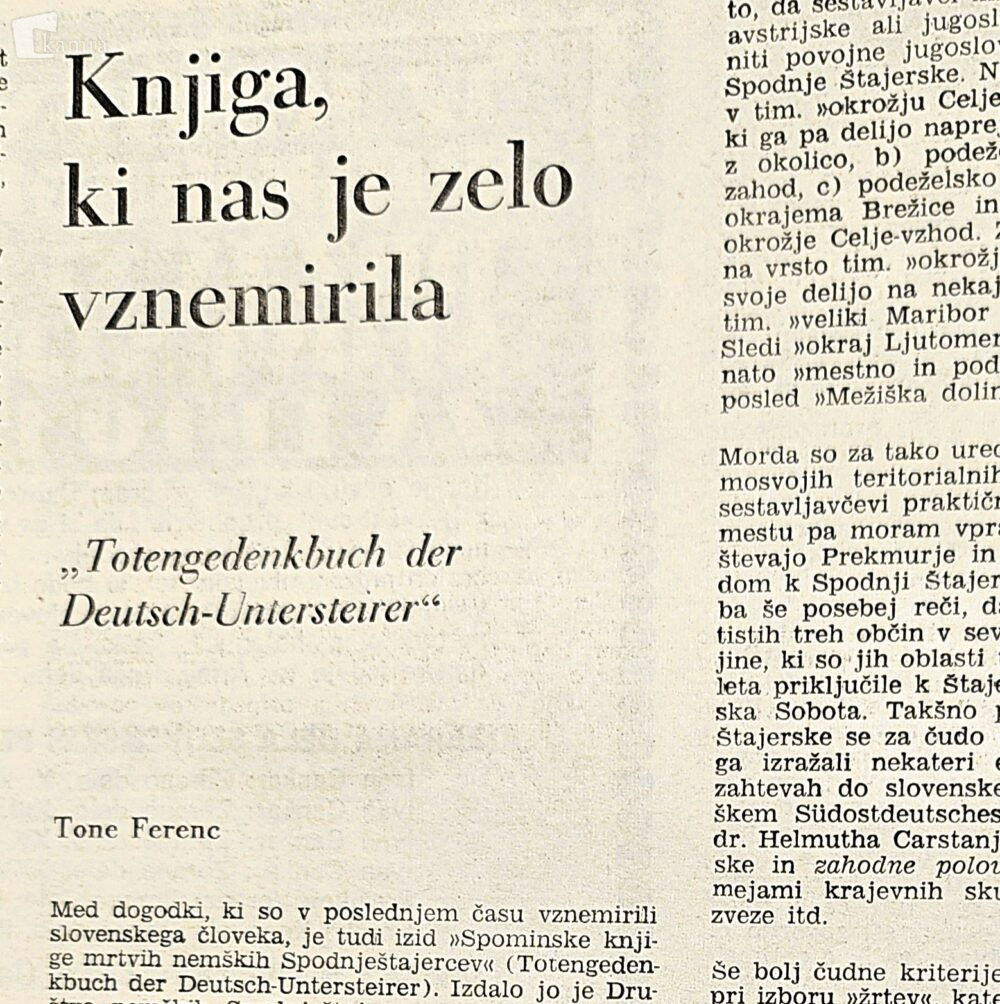
Ferenc analyzed the Totengedenkbuch in detail and summarized his findings in the article “The Book That Disturbed Us”, published in Naši razgledi (Our views) on 12 March 1971. He was highly critical of the use of the term “innocent victims,” of the categorization of victims by region, of incorrect street names in Maribor, and even of the way Slovenian diacritics were written. He accused the anonymous authors of “low political intentions” and expressed concern that official Austrian politics might not remain indifferent to the publication.
Ferenc evidently checked all 4,600 names listed in the book. He identified 70 individuals as collaborators in the occupier’s crimes or as part of the occupation apparatus, and for several hundred more he concluded they had been informants of the NSDAP provincial office or members of the Wehrmannschaft. For more than 4,000 names, however, he raised no objections to their inclusion and did not dispute that these individuals had lost their lives violently in 1945. Indirectly, Ferenc’s article in Naši razgledi in March 1971 may have been the first public acknowledgment of post‑war killings on the territory of present‑day Slovenia.