
“Revolutions tear down to build, yet in doing so they sometimes destroy much that would not have needed to be destroyed. They seek new paths and in doing so often make mistakes. Those strata of the people who were nothing only yesterday become, through the revolution, a decisive social force, yet they carry with them also the traits from the times of their complete lack of rights. Therefore, they bring nations progress, but also eruptions of hatred that accumulated in the times of their oppression and their struggle of life and death for their own fate. Our revolution, too, could not remain untouched by the influence of such objective laws.”
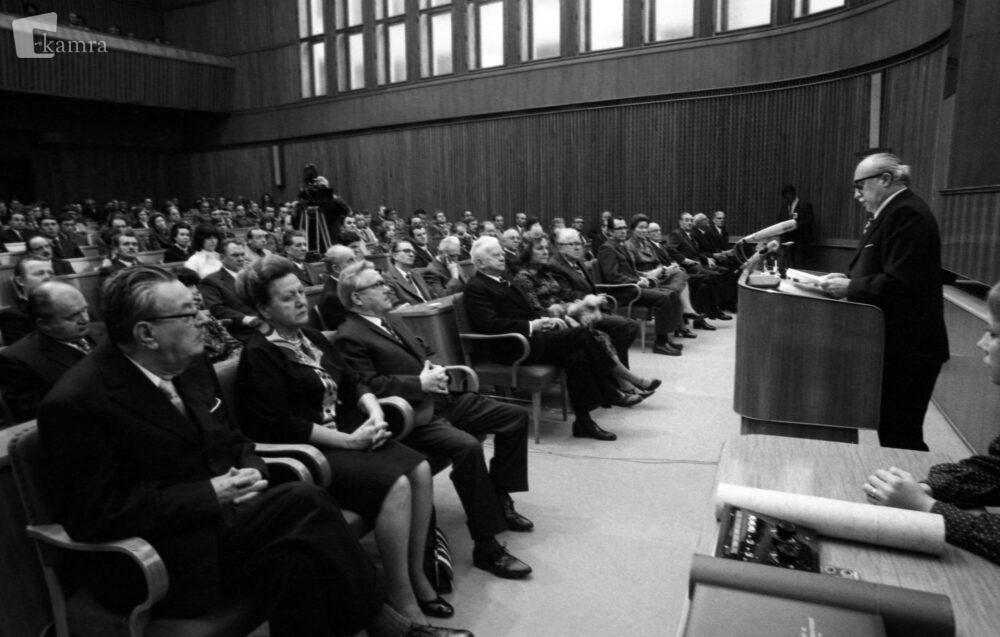
These grand words were written by Edvard Kardelj — the second most powerful man in the former Yugoslavia — in a 1975 volume honoring Josip Vidmar, the first post‑war president of the Slovenian National Assembly. On 13 October 1975, an extraordinary, expanded session of the Slovenian parliament was convened in Vidmar’s honor. The photograph from that event shows Vidmar seated in the front row, fourth from the left; Kardelj is third from the left; at the podium stands Mitja Ribičič, then the highest‑ranking Slovenian politician in Yugoslavia and a key wartime and post‑war operative. Ribičič is connected to Leopoldina Pečar through his June 1945 dispatch praising the suitability of the Strnišče concentration camp: “It has 7 km² and can accommodate … 20–25 thousand Schwabs.” Kardelj is connected to her fate through another June dispatch: “At the latest within three weeks the Courts of National Honour will be dissolved … You therefore have no reason to be as slow in the cleansing as you have been so far.”
Vidmar himself never wrote so directly about the post‑war killings, but in 1929 he wrote a scathing critique of Seliškar’s novella Rudi: “… I may risk the judgment that with this fragment the old type of our youth tale has been restored in all its misery. /…/ The previous ‘central personalities’ of Slovenian literature did not write such poor works.” Tone Seliškar surely did not forget this, and perhaps that is why in May 1945, in his article Revenge is a terrible word, he wrote so unequivocally: “The President of the Slovene National Liberation Council, Josip Vidmar, uttered this terrible word. But our revenge is not blind, senseless revenge such as guided the occupier’s lackeys and butchers /…/ No, we know nothing of that; rather, the President, in the name of the entire nation, promised the victims that everything rotten, base and bestial that remained in our nation must disappear!” I reflect: If Vidmar — fifty years old in 1945, widely read, admirer of world thinkers — believed in the illusion that a new man could be created by eliminating all who did not fit the new criteria, how can I blame the blacksmith’s apprentices for their bloody deeds?
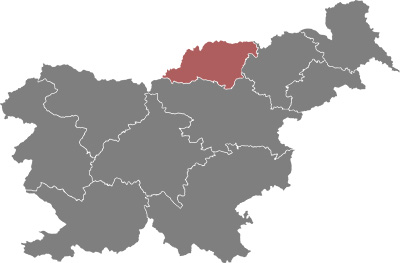
Over two years, I examined hundreds of pages of documentation on the actors of post‑war events in Styria and produced nearly as many notes. When I reflect on the guilt of individuals who encouraged, allowed, or carried out such extensive revenge based on collective guilt, I paraphrase Vidmar’s wisdom –“I once wrote that there are as many kinds of deaths as there are lives, and that they are such as the lives are.” –from his final book Dance of Death. I say, for the dances of death on Pohorje, on the Drava Plain and elsewhere in Lower Styria there are as many faults, and of such kinds, as there were perpetrators and as their lives had been. It was not equally easy to forgive all of them.
At the top of the hierarchy of Slovenian post‑war decision‑makers stood Edvard Kardelj, who turned thirty‑five in 1945. His reflections on the unintended consequences of revolution were written in 1975, months after the publication of Kocbek’s testimony on the post‑war killings. He did not write them spontaneously — but they read sincerely. As I write this at sixty‑five, reflecting on the weight of one’s youthful actions or words, I must admit that at thirty‑five I too did the best and worst things of my life. I wish only the former remained in memory, but the latter haunted me. Objectively, I did nothing truly terrible — I took no one’s dignity, let alone life. But I was never placed in situations where I had to decide about life and death. I cannot know whose uniform I would have worn in Styria had I been born fifty years earlier, in which direction I would have radicalized, or how I might have stained my soul under an oath of loyalty to one illusion or another.