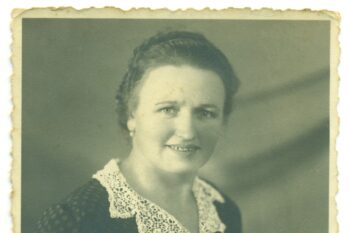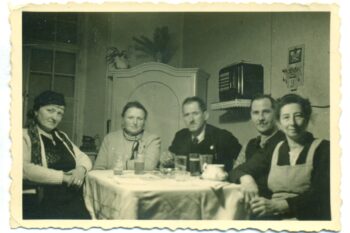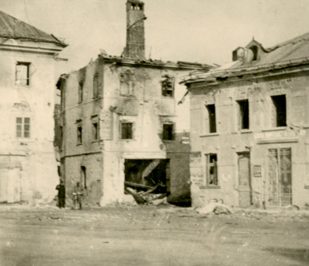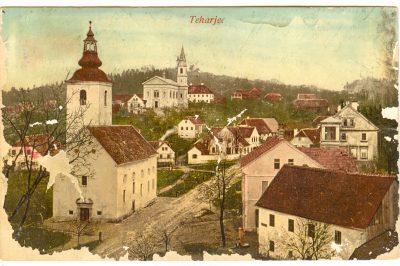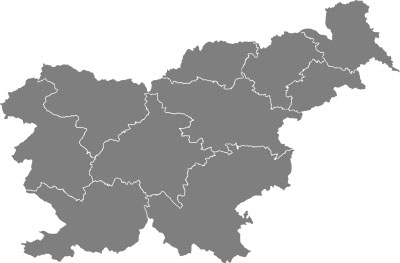

After the Anschluss—the annexation of Austria by National Socialist Germany—in the spring of 1938, life and the general atmosphere in Maribor and its surroundings began to change. People divided according to their beliefs and expectations. The German‑minority organization Kulturbund received permission to resume its activities, and in early 1940 a Kamnica branch was established as well. Leopoldina, who had become a single mother after her husband left, joined it three months before the outbreak of the war.
In the 1935 directory, the Schwäbisch‑Deutscher Kulturbund was listed among educational, cultural, and national‑defence associations whose purpose was to foster professional identity and education among its members. In reality, however, its leading members had already before the war compiled lists of nationally conscious Slovenes and of those who had settled in Styria between the two wars, marking them for expulsion. After the occupation, they became part of the administrative and repressive apparatus; some participated in the so‑called mobile racial‑assessment commissions. Because of collaboration with the occupier and the crimes of individual members, the Kulturbund was after the war collectively declared “…an explicitly treasonous organization which, already in pre‑April Yugoslavia, was preparing the way for the occupier, … and after the occupation the KB members … publicly welcomed the occupation and the deliverance from the Serbian yoke, spied, and persecuted Slovenes.”
The testimony of C. T. in file ZP 722/46 describes Leopoldina’s entry into the Kulturbund as follows: “Some 10 or 12 days before the outbreak of the war in 1941, she entered the KB under the pressure of Rupreht, a postal employee. The said man came to her with a sheet on which he already had written several members who had joined the KB and began threatening her that he would have her husband, Pečar Bogomir, imprisoned in Austria if she did not join the KB. At the same time, he also promised her support if she entered the KB, and because of these promises and threats she then joined the KB. I was present on this occasion, as I had gone to Pečar’s to get some lettuce, and she told me outside, when Rupreht called her into the room, that she did not want to join the KB. The said man had come to her three times, and twice she refused to join, but the third time she gave in and joined.”
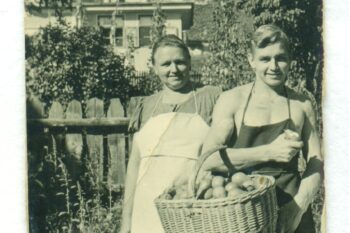
As a result, in May 1941 Leopoldina was admitted directly into the wartime German political organization Steirische Heimatbund and received the so‑called red identity card, which granted her full permanent German citizenship. She was assigned the lowest function, Blockhilferin, responsible for collecting the so‑called Winter Relief in the village. She continued to support herself through work at home and in the inn across the street. Her niece Vikica, who often visited her as a child during the war, recalled: “Aunt went every morning to the inn and the butcher shop of her former father‑in‑law to work. /…/ She was a servant, a maid; she did everything. /…/ She had her own sheds in the yard; there she kept her chickens and pigs. She was literally a real farm woman. She wasn’t dressed any differently either; in the true sense a peasant woman.”
Leopoldina received great help during the war from her son Hansi, who, due to his disability, was not drafted into the German army and remained at home. Her daughter Poldika visited only occasionally from Prlekija, where she ran a kindergarten in Stročja vas. Leopoldina’s niece remembered her last visit at the end of March 1945: Aunt came and said: “Heute kommt Poldi zu Hause.’’ She will come home today – we must pick snowdrops. And on the (Maribor) island we picked snowdrops so that the whole room was full of flowers.
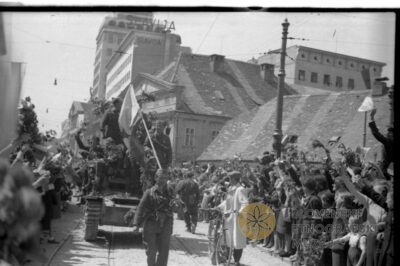
On Easter Sunday, 1 April 1945, the Styrians most loyal to the occupier began fleeing en masse to the north and west. Leopoldina did not join them, because her daughter Poldika urging her to stay. Her daughter’s words – ‘’You haven’t done anything wrong” – soon proved fatal.