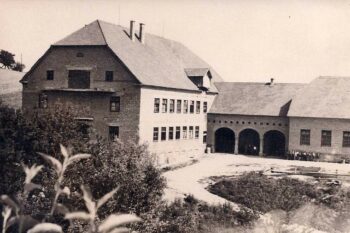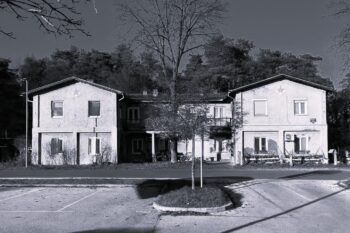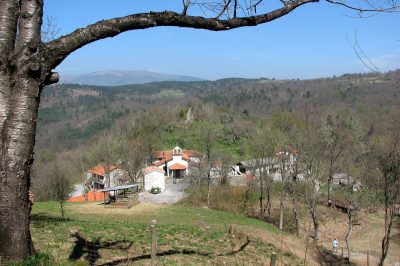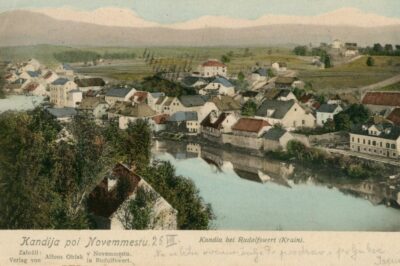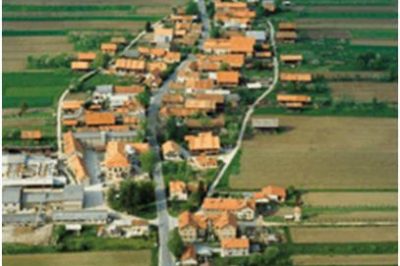

The liberation of Kamnica on 9 May 1945 was described after the war by a local comrade as follows: “The Bulgarians came to the place first, plundering and stealing. At the same time the partisans also occupied the place. /…/ The population was enthusiastic and joyful!” In the night of 25 May 1945, Leopoldina, her daughter Poldika, her son Hansi, and five other villagers were arrested and taken to the collection center in Pesnica. The next day, the newspaper Slovenski poročevalec (Slovenian Reporter) published its first article under the headline: “Revenge is a terrible word.”
In the highly emotional article signed by the popular youth writer Tone Seliškar, one reads: “And so, beside this terrible pit, revenge became our program. /…/ And we shall overcome /…/ the scruples that would hinder us in carrying out this mission of revenge, for the victims must be avenged, and avenged in such a way that this revenge will reach down to the very deepest roots. We shall not only cut down the rotten tree; we shall also tear out its roots and burn them”. How much these fervent words were meant for Leopoldina, and her Styrian neighbours is impossible to say, but they certainly influenced their fate—and the fate of their descendants.
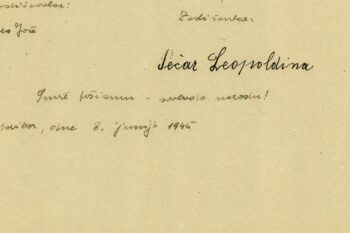
Upon arrival in Pesnica, the detainees had to write statements about their wartime activities; these are preserved in their personal files. Handwriting and content analysis show that detainees with poor Slovene skills had their statements written by fellow prisoners. Leopoldina’s statement was written at the end of May 1945 by her daughter Poldika, who, after three weeks, was released from the Pesnica prison under unclear circumstances. Her brother Hansi was taken ten days after the arrest to the Strnišče/Sterntal concentration camp near Ptuj. “I experienced and saw much there /…/” he wrote in his autobiography fifty years later.
On Thursday, 7 June 1945, Leopoldina was transferred to the Maribor judicial prison, where the next day she was interrogated by a twenty‑year‑old security officer, Jože K. In a small, neat hand, he summarized her personal data, her entry into the Kulturbund due to social pressures, and the names of fellow villagers who were members and held various functions. From the 38 interrogation records dated 8 June 1945—prepared by seven interrogators—it appears that interrogations lasted no more than half an hour and were often hindered by poor knowledge of Slovene or German. Based on these records, indictments were prepared, most of them like Leopoldina’s: “She was a member of the KB and a fanatical Hitler supporter.” The files also contain large three‑digit numbers written in wax crayon or the word transport, believed to indicate that the individuals were executed in the forests near Areh on Pohorje in the following days.
In Leopoldina’s file, the first page bears the number 529, which initially led us to assume that her final journey ended in one of the Pohorje mass graves. But according to testimony obtained in 2024 from her niece, we now know that Leopoldina was still alive on Sunday, 5 August 1945, when an international Red Cross delegation visited the Strnišče camp. The delegation was driven there by her younger brother Alois, who, under the third regime, worked as a driver for the Maribor municipality. When he returned home, he reportedly said in agitation: “You know, she refused to go!” His daughter, then eleven, still remembered his words clearly at ninety: “Sit in the car, I’ll take you now, I told her. But she replied, I haven’t done anything wrong, I will come home.” The last news that reached her brother Alojz was: “Sister fell unconscious the day after she had to part from her children.”
Since we know that Leopoldina’s son Hansi was released on 7 August 1945, we could picture the least cruel possibility of her death. Perhaps she suffered a stroke on 8 August 1945 and, like many others, was buried anonymously near the camp, or her unnamed body was sent to the cemetery in Lovrenc on the Dravsko polje. Another possibility is one of the violent forms of execution in the vicinity of the camp or on Pohorje, as various sources on post‑war killings in Styria suggest. Expulsion across the border in August 1945—experienced by many Styrians with German citizenship or identity—is unlikely, as Leopoldina never contacted her sisters in Austria nor returned to her home in Kamnica.