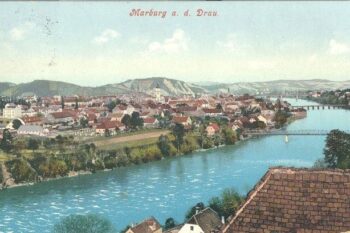

Leopoldine Köberl was born on 17 January 1901 in the family home at Koroška cesta 114 in Maribor. At that very time, parliamentary elections were taking place in Austria‑Hungary. In Maribor, the majority of votes went to the German national party Deutchbürgerlichen. Almost all remaining votes were cast for the SDP, the Austrian Social Democratic Party, on whose list Leopoldina’s grandfather, Carl Anton Dobetschar, was also a candidate.
Carl Anton was born in 1850 at the address Marburg 233, in the large building at today’s Vojašniška ulica 21–23 in the heart of Lent. His ancestors came from the eastern edge of the Slovenske gorice; his surname, written in various forms, is of Slavic origin (Dovečer). Yet, like most Maribor townspeople of the time, Carl read the Marburger Zeitung and spoke German. He passed this German identity on to his seven children, whom he and his wife Maria (née Dworzsak) raised respectably in a small house on the outskirts of town. Historians would describe Carl Anton—who died in 1913 after a severe illness—as a typical Steirischer (orig. štajercijanec).
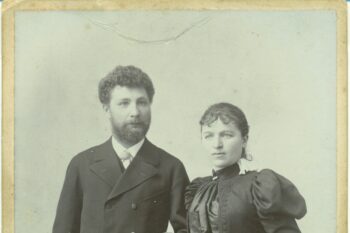
The eldest of Carl’s daughters, Leopoldina’s mother, Maria Carolina Dobetschar (born 1875), lost her mother at nineteen, became pregnant almost at the same time, and married a year later. Her husband, Leopoldina’s father, was Theodor Köberl, born in 1871 in Graz to a toolmaker and a washerwoman. He trained as a miller, came to Maribor around 1890 to stay with relatives, and found work as a warehouseman for the Southern Railway. Thanks to his file from the Maribor prison—where Theodor served a three‑month sentence at the end of 1898—we also know that he was 160 cm tall, strongly built, brown‑haired and blue‑eyed, healthy in appearance, with good teeth, and that he did not speak Slovene.
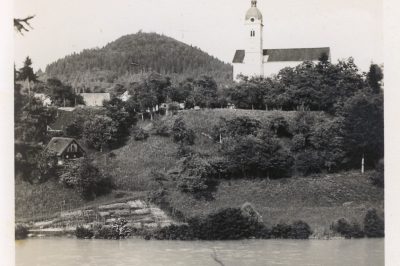
Maria Carolina, who sold home‑grown vegetables at the market, and Theodor lived modestly in a one‑room apartment in her father’s house on Koroška cesta. Between 1896 and 1910 they had seven children—three daughters and four sons. We can easily imagine that all the children helped early on with the garden and the household animals. Leopoldina and her older sisters surely looked after their younger brothers. And on the banks of the then fast‑flowing, clear Drava River, they enjoyed carefree moments, as a family note recalls ‘’I played there; there were plenty of pebbles and sand, and we even swam.”
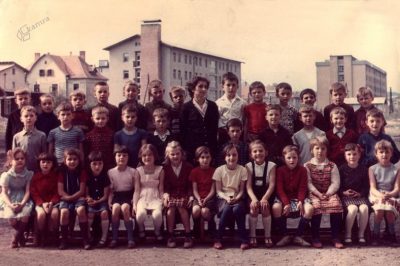
In the autumn of 1907, Leopoldine entered the first grade of the Sechs klassige Mädchen Volksschule in Marburg, housed in the imposing building that today belongs to the University of Maribor. School life in the very center of the city—together with girls from well‑to‑do Maribor families—was likely not easy for her. Conditions at home on Koroška cesta 114 were tense, and the family’s finances fragile. This is suggested by a notice published in March 1908 in the Marburger Zeitung: “I hereby warn everyone not to give my husband any money or valuables, nor to allow him instalment payments, as I will in no case be responsible for payment. Marie Köberl.”
Despite the difficult circumstances, Leopoldina’s family grew again in 1910 with the birth of another son. In 1912, her unreliable father, Theodor, died in the Maribor hospital, leaving her mother, Maria, alone with six children.
The early 20th century was also a turbulent political period in Styria. Tensions between committed Slovene and German nationalists grew increasingly sharp. In September 1908, the Ptuj incidents occurred—sometimes described in humorous terms: “Germans and Slovenes on the battlefield in Ptuj … Sticks and stones flew, windows and bones cracked.” The events in Ljubljana a week later were no longer humorous: the students Ivan Adamič and Rudolf Lunder lost their lives. How much of this Leopoldina heard about at school is hard to say. But she certainly heard the Imperial Song read from the school reader more than once: “May God preserve and protect our emperor and Austria. May He grant him wisdom in ruling, supported by the true faith. Let us defend his hereditary crown against all enemies. With the Habsburg throne shall Austria’s lasting fortune endure.”