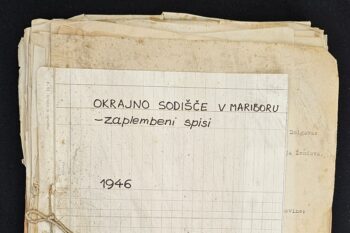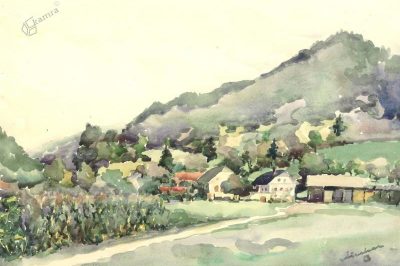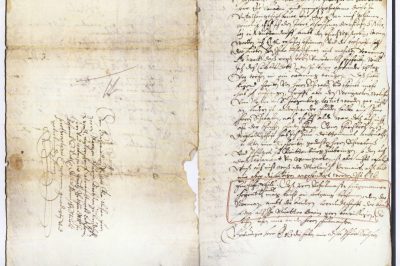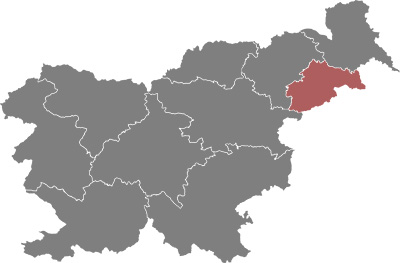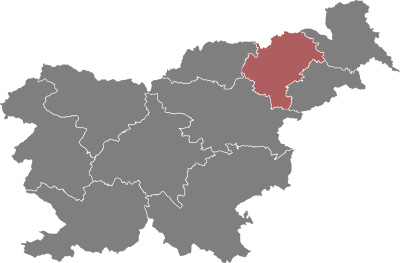

At the end of August 1945, the secretary of the District Confiscation Commission in Maribor filled out more than two hundred forms titled Decision on the Confiscation of Property. The legal basis was Article 1 of the AVNOJ Decree on the transfer of enemy property into state ownership, which defined as enemy property also “all property belonging to persons of German nationality.” Decision no. 177 states that all property is confiscated from: Pečar Leopoldina, former owner of the house with garden in Kamnica no. 23, of unknown residence.
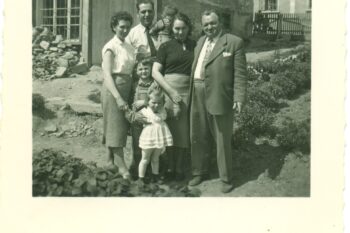
At the end of August 1945, the house with the garden at Kamnica 23 was occupied by Leopoldina’s daughter Poldika, her son Hansi, and their stepfather Bogomir, Leopoldina’s second husband. In early June he had returned on foot from the British occupation zone in Austria and soon began working on the construction site of the hydro power plant Mariborski otok. Just as he had avoided the front during the First World War thanks to his father’s position as mayor, he also escaped the fate of most Kamnica members of the Kulturbund after the Second World War. Perhaps it was simply due to an error in the list, where someone wrote his surname Pečar as Tičar. In any case, Bogomir Pečar appealed Decision 177 and received a letter in late December 1945 stating that his request for annulment of the confiscation had been granted. Nothing changed, because the district confiscation commission had no authority to reverse such decisions.
Leopoldina’s son Hansi did not wait for the decisions of the new authorities. In mid‑November 1945, he crossed the green border about ten kilometers northwest of Kamnica. According to family tradition, he and his sister Poldika agreed that she would stay home in case their mother returned, while he would go to Austria to look for her. That the family still believed for some time that Leopoldina might be alive is confirmed by a line in the farewell letter written by the terminally ill Bogomir Pečar in January 1948 in the tuberculosis hospital at Golnik: “until my wife returns …”
Shortly after his death, the Local People’s Committee of Kamnica replied to Poldika’s request to rent the garden plot and apartment: “Your request cannot be granted /…/ The apartment is temporarily left to you until it becomes necessary to assign it as a two‑room unit to a larger family.” Fortunately, this never happened, and Poldika—who behaved impeccably under careful supervision in the new state—was allowed to remain in the attic room of the house at Kamnica 23.
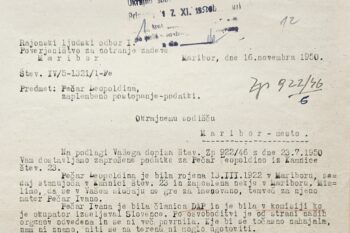
In April 1950, through the Maribor lawyer Dr. Krulec, Poldika filed a request to reopen the confiscation proceedings. The court appears to have handled the case properly: on 20 June 1950 it heard four witnesses and twice urged the City Committee of the Liberation Front to immediately provide information about Leopoldina’s conduct before and during the occupation. In a confused response titled Characterisation, signed in November 1950 by Captain Milan V., it was stated: “After the liberation she was taken away by our authorities and did not return. Where she might be at this time is not known to us, nor could it be established on the ground. /…/ She was a member of the DAP and was on the commission when the occupier was expelling Slovenes. /…/ She deserved that her property be taken or confiscated. /…/ … it would be unfavourably received by most conscious people if the property were returned.”
In the first instance court accepted this as evidence and on 19 February 1951 ruled that the request to reopen the confiscation procedure was rejected. In the second instance court likewise did not question the statements of the officer of the Yugoslav secret police (UDBA). Instead, it questioned the legal standing of the appellant, Poldika, since her statement “that the liable party disappeared without a trace after her arrest, even if true, cannot substitute for an official declaration of death.” Although Mr. Krulc was remembered as a highly experienced lawyer, this was not enough in the early post‑war years to obtain a proper rule on Leopoldina’s fate.