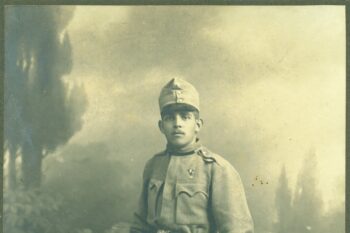
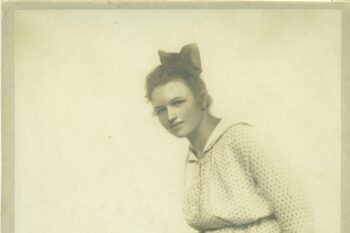
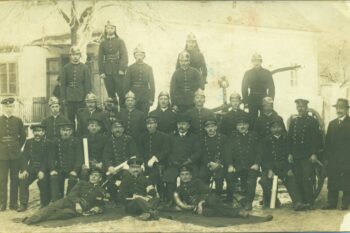
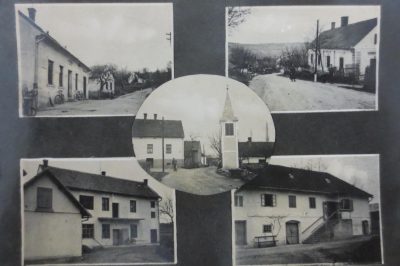
In June 1914, when thirteen‑year‑old Leopoldine was in the final year of elementary school, the Sarajevo assassination took place. A month later, Austria declared war on Serbia, and at the end of August 1914 a horrific three‑day battle unfolded in Galicia between the Austrian and Russian armies. Among the half‑million dead and wounded were soldiers of the Styrian‑Maribor 47th Infantry Regiment. With their return, the shadow of the war also fell over Maribor, far from the front, and lingered until the very end of Leopoldina’s teenage years.
Under the school laws of the time, Leopoldine was required to attend school until the age of fourteen. Her final certificate, a large thick sheet titled Entlassung‑Zeugniss and dated 18 January 1915, contains many excellent marks: conduct, religious instruction, natural science, geography and history, singing, and gymnastics. She received “very good” for diligence, reading, arithmetic, and needlework, and “good” for writing, penmanship, and the second language—Slovene as the Unterrichtssprache.
After finishing school, Leopoldine stayed at home on Koroška cesta, where she lived during the war with her mother Marija, her older sister, and three younger brothers. A line in Marija’s will reads: “I worked hard with my children so that I could remain in my parents’ home /…/ My youngest daughter understands the farm and can take it over …” This suggests that Leopoldina was her mother’s right hand in running the smallholding and selling produce at the Maribor market.
Shortly before Leopoldina’s sixteenth birthday, on 21 November 1916, Emperor Franz Joseph died after sixty‑eight years on the throne. By then, the war had deeply affected everyday life in Maribor, even though the city lay far behind the lines. At the main railway station, soldiers departing for or returning from the front mingled daily with refugees seeking shelter in the city. Life during the war could not have been pleasant for Leopoldina and her peers, and it became even more difficult after the armistice, when crowds of soldiers of all nationalities streamed back through Maribor. After the political upheaval at the end of October 1918, a serious struggle for dominance began in Styria between Austrian and Yugoslav patriots.
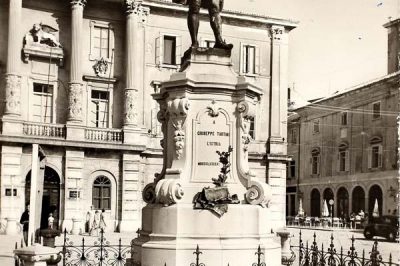
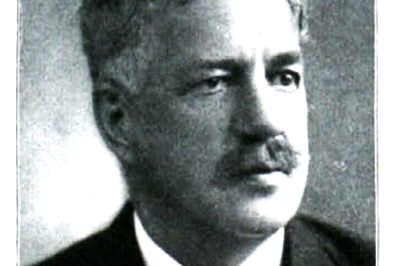
Tensions spiralled out of control a few days after Leopoldina’s eighteenth birthday, on Monday, 27 January 1919—the day known as Marburger Bluttag. Perhaps Leopoldina was cooking at home when history quite literally passed by her house on Koroška cesta in the person of American Lieutenant Colonel Sherman Miles. Moments earlier, his study delegation had met with General Rudolf Maister and representatives of the National Council to discuss the future border between the new Austrian republic and the South Slavic kingdom. Meanwhile, a crowd of German‑minded Maribor residents was converging on the Town Hall from all directions. When, in the view of Maister’s guards, they came too close, the guards opened fire. Leopoldina’s younger brothers—Hermann, Alois, and Peperl—whose classes had been cancelled that day, must have been somewhere at the back of the crowd. They likely recounted the dead and wounded on the Main Square later that afternoon, which may explain why a rather cool attitude toward the famous townsman survived in family memory.
By the autumn of 1919, political conditions in Maribor and Styria had calmed, and the city began to recover economically what was also felt in the life of Leopoldina’s family. Her older sisters and eldest brother, like many of their peers and fellow townspeople, soon left for Austria after the First World War, but Leopoldina remained in Maribor. She became an attractive young woman and became engaged in the summer of 1920.