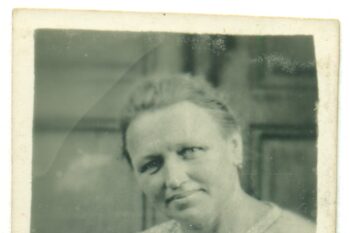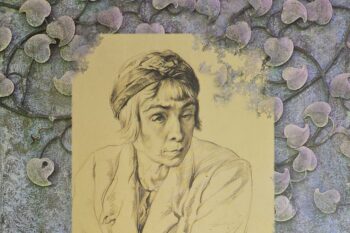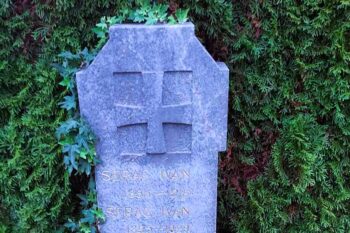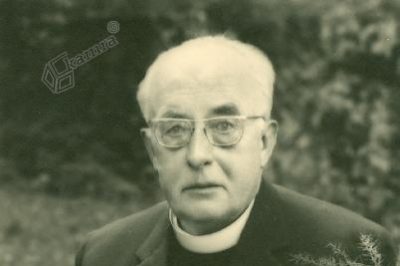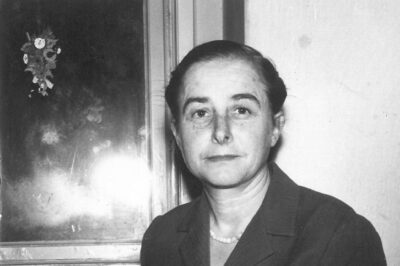

In November 1901, the year of Leopoldina’s birth, her older little brother Alois Theodor died of measles at the age of four. After the First World War he disappeared from family memory; the only trace of him is a short notice in the Marburger Zeitung. At Leopoldina’s death, no record was made, and with the passing of her grandchildren she would have vanished entirely from both family and public memory. This text, written on the 125th anniversary of her birth, attempts to preserve her memory and to understand the events that shaped the descendants of her generation.
Had Leopoldina boarded the train to Carinthia in April 1945 and built a new life among her brothers and sisters somewhere in Austria, her relatives would have written upon her death: “Unsere herzensgute Mutter … / Our dearest mother, grandmother, sister, sister‑in‑law, aunt … She was simple, hardworking, tireless, a devoted mother of two children and a faithful wife … Her life was one of love, kindness, and helpfulness.” At an open grave in St. Peter‑Stadtfriedhof or somewhere else in Upper Styria, her relatives would have stood, my other self, and her daughter Poldika, silently thinking her own thoughts. She would never have voiced reproaches: that her mother remarried too soon, that she did not protect her from the harshness of her stepfather, that she did not stand up for her when the aunts decided her professional future. Only she would have known how ashamed she felt as a twenty‑year‑old young lady of the poorly dressed housewife from Kamnica visting her in genteel Graz. One simply does not speak of the perpetual tensions between mothers and daughters.
But Leopoldina did not live to be eighty‑five like her sisters, and she never had a funeral with a farewell speech. Her place of remembrance was a golden locket on a chain that her daughter Poldika wore every morning to Mass. Inside were tiny photographs of her mother and father. She opened it before me only once; yet neither in sorrow nor in joy did she ever speak of her mother’s character. So, I can only guess Leopoldina’s traits, after finally sensing her as my grandmother following two years of research.
She undoubtedly loved her children deeply, especially her son Hansi, who was always by her side. She must have been conscientious in carrying out tasks and trustworthy enough to collect membership dues. She was surely obedient toward those she perceived as authority figures. She was evidently stubborn, insisting on speaking her mother tongue when it was no longer wise. She must have been reckless not to flee when everyone around her fled. That she did not seize the last chance to escape the camp, even though she saw and heard what was happening, seems almost mad. But wartime decisions often appear mad from today’s perspective.
After two years of intensive research and reflection, I could not determine exactly when and how Leopoldina died, but I know with certainty that she committed no crime. She was simply a victim of the identity in which she grew up. Today we call it German, though it was more Austrian in the sense of loyalty to the Viennese emperor—or simply Styrian. She probably did not think much about her identity, but she persisted in it linguistically. That persistence proved fatal for her and for millions of ordinary people in the Second World War. They were not, like Alma Karlin, citizens of the world who could recognize the evil intentions of great leaders and refuse to follow them.
During the research into my grandmother Leopoldina’s fate task that consumed me for nearly a year I experienced many emotions. First came the vague guilt my mother had unknowingly passed on to me. Then came deep sadness, increasingly mixed with anger. Anger at all who had lied to me about (Styrian) history; anger at my favorite childhood writer. I felt betrayed that my beloved Tone Seliškar had written such a blood‑soaked call for revenge. But my greatest anger was reserved for the gentlemen and comrades who decided Leopoldina’s fate. And yet my mother, Leopoldina’s daughter Poldika, left me one final message: “I am no longer angry with you.” When I accepted that, I could forgive the writer for that article on revenge. And so, I believe that Leopoldina, too, forgave the young men with rifles—her gravediggers and at the same time hostages of the deranged masters of their time. May she—and they—rest in peace.