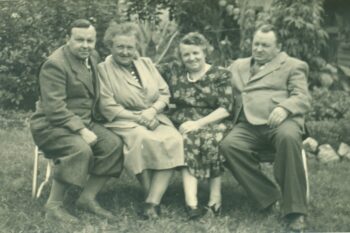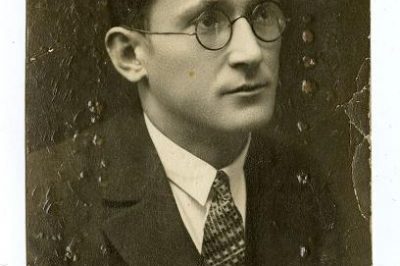

Around 1950, an employee of the State Security Administration placed the interrogation record and indictment of Leopoldina Pečar into a file folder and marked it KB‑2985. For the next forty years, no one opened the file again, and no one spoke publicly about the post‑war events in Styria. Even Leopoldina’s daughter rarely spoke about her mother; only at the Kamnica cemetery, while tending the family graves, she would whisper: “But I have no grave for her.”
The file of Leopoldina Pečar—renumbered after the war as ZA‑450/3414—is today stored in the Archives of the Republic of Slovenia in box 1931_911. Its contents were the first official information her daughter Poldika received about her mother in December 1992, more than forty‑seven years after their farewell. The request for information had been submitted by Leopoldina’s grandson Darko shortly after Slovenia’s independence, at a time when expectations about uncovering the fate and legal status of the wartime missing were high—too high, in fact.
Although it took only six months for Leopoldina Pečar to be entered into the Maribor register of deaths in July 1993, the determination of her citizenship dragged on for eight years. Only in 2001—coincidentally the centenary of her birth—did the Maribor Administrative Unit issue a declaratory order stating that at the time of her death, Pečar was considered a Yugoslav citizen. Ironically, she obtained this citizenship through her marriage to Bogomir Pečar, who thus determined her fate once again.
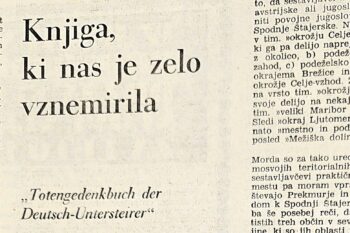
After this final decision, the case of Leopoldina Pečar sank back into the silence that still surrounds the fate of thousands of Styrian grandmothers and grandfathers whose names fill the twenty‑four boxes of the KB collection. Silence about them in the former state, the Socialist Federal Republic of Yugoslavia, is understandable to a degree. Even democracies struggle to face their recent past—how could a dictatorship have tolerated critical examination of its own origins? After the prevrat (coup) —the historians’ preferred term for the great upheavals of the 20th century—silence often took the form of incomprehensible shouting. As children of socialism, we find it difficult in old age to accept that we must relearn the history of our parents’ youth and our own. It is difficult for everyone, impossible for many, and silence remains the most comfortable solution.
More difficult than societal silence, however, was understanding the silence at the level of the individual and the family. At first, I interpreted it as fear of judgment, fear of consequences. Later I read that survivors often remain silent out of guilt toward those who had not been as fortunate. Shame also played a role—shame from humiliation, or from one’s own actions. Over time, I began to associate silence with pride as well—the pride of survivors who endured injustice, suffering, and abuse, yet stood up again and reclaimed their place under the sun. And I realized that just as we cannot judge wartime and post‑war events by today’s standards, modern psychology cannot fully explain that era either.
Why Leopoldina’s daughter Poldika, after 1990, like many of her contemporaries—did not seek additional information about her mother remains an open question. Perhaps she knew everything but did not speak because she was afraid, ashamed, guilty, and proud all at once. I am convinced, however, that my mother Poldika wanted the story of grandmother Leopoldina to be uncovered and not lost to oblivion. In one of her many letters, written ten years before her death, she told me: “I have endured much, it was too hard, and I will not speak so as not to make myself out to be a saint /…/, no one would believe it if I were to tell anything. /…/ Even though you, who studied psychology, could investigate such things and delve into them.” Thirty years later, I felt it was time to fulfill her wish and return spiritually home to Styria.